 1.855.305.2430
How to Read Your DNA Test Results: A Step-by-Step Guide Leave a comment
Key Takeaways
- DNA test results contain multiple sections, including ancestry composition, health information, trait predictions, and raw genetic data that require different approaches to interpretation.
- Understanding confidence levels and probability statistics in your results is crucial – most findings represent risk factors or possibilities, not definitive diagnoses or predictions.
- Different testing companies use varying reference populations and algorithms, which explains why results may differ between providers like 23andMe, AncestryDNA, or MyHeritage.
- Sequencing.com provides powerful tools to help interpret your raw DNA data, regardless of which testing company you originally used.
- Consulting with a genetic counselor is recommended when interpreting health-related genetic findings to understand their true significance for your well-being.
Opening a DNA test report for the first time can feel like trying to read a foreign language. Those colorful charts, percentages, and scientific terms might seem overwhelming, but with the right approach, you can unlock valuable insights about your genetic makeup. This guide breaks down the process of interpreting your DNA test results into manageable steps, helping you understand what your genes are actually telling you.
DNA Test Results Explained: What You’re Looking At
DNA test results are essentially a snapshot of your genetic code, analyzed and presented in a user-friendly format. When you first log in to your testing company’s portal, you’ll typically see a dashboard with different categories of information. These might include ancestry composition, health predispositions, carrier status for certain conditions, trait predictions, and access to your raw data. Each section requires a different approach to interpretation and offers unique insights about your genetic makeup.
Different Types of DNA Tests and Their Results
Not all DNA tests are created equal, and understanding which type you’ve taken is crucial for proper interpretation. Autosomal DNA tests, like those offered by 23andMe and AncestryDNA, analyze DNA from all 22 pairs of autosomal chromosomes and are excellent for finding recent relatives and broad ethnic ancestry. Y-DNA tests examine the Y chromosome passed from father to son and can trace your paternal lineage. Mitochondrial DNA (mtDNA) tests look at the DNA in your mitochondria, which is passed from mother to child, revealing your maternal lineage. Medical-grade genetic tests, usually ordered by healthcare providers, tend to be more comprehensive and focus on specific health conditions or inherited disorders.
Common Sections Found in Most DNA Reports
Regardless of the testing company, most DNA reports include several standard sections. The ancestry composition section displays your ethnic heritage as percentages, often with interactive maps showing geographical distributions. Health-related sections may include carrier status reports for genetic conditions, disease risk assessments, and pharmacogenetic information about how your body might process certain medications. Many reports also include trait predictions – from eye color to taste preferences – and provide access to your raw genetic data. Some services also offer relative-matching features that identify potential genetic relatives who have also taken the test.
Sample DNA Report Structure
• Ancestry Composition (ethnic percentages)
• Health Predispositions (disease risks)
• Carrier Status (recessive genetic variants)
• Trait Reports (physical and sensory traits)
• Relative Matches (potential family members)
• Raw Data Access (complete genetic information)
Raw Data vs. Interpreted Results
There’s an important distinction between the raw data from your DNA test and the interpreted results. Raw data consists of hundreds of thousands of genetic markers presented as a string of letters (A, T, G, C) representing your genetic code at specific locations. This information is virtually meaningless without proper analysis. The interpreted results are what testing companies present in their user-friendly dashboards – the translation of that raw data into understandable insights about your ancestry, health, and traits. The interpretation layer is where most of the value comes from, but it’s also where differences between testing companies emerge, as they each use different reference populations and algorithms to analyze your genetic information. For more information, you can explore how ancestry and health DNA testing differ in their approaches.
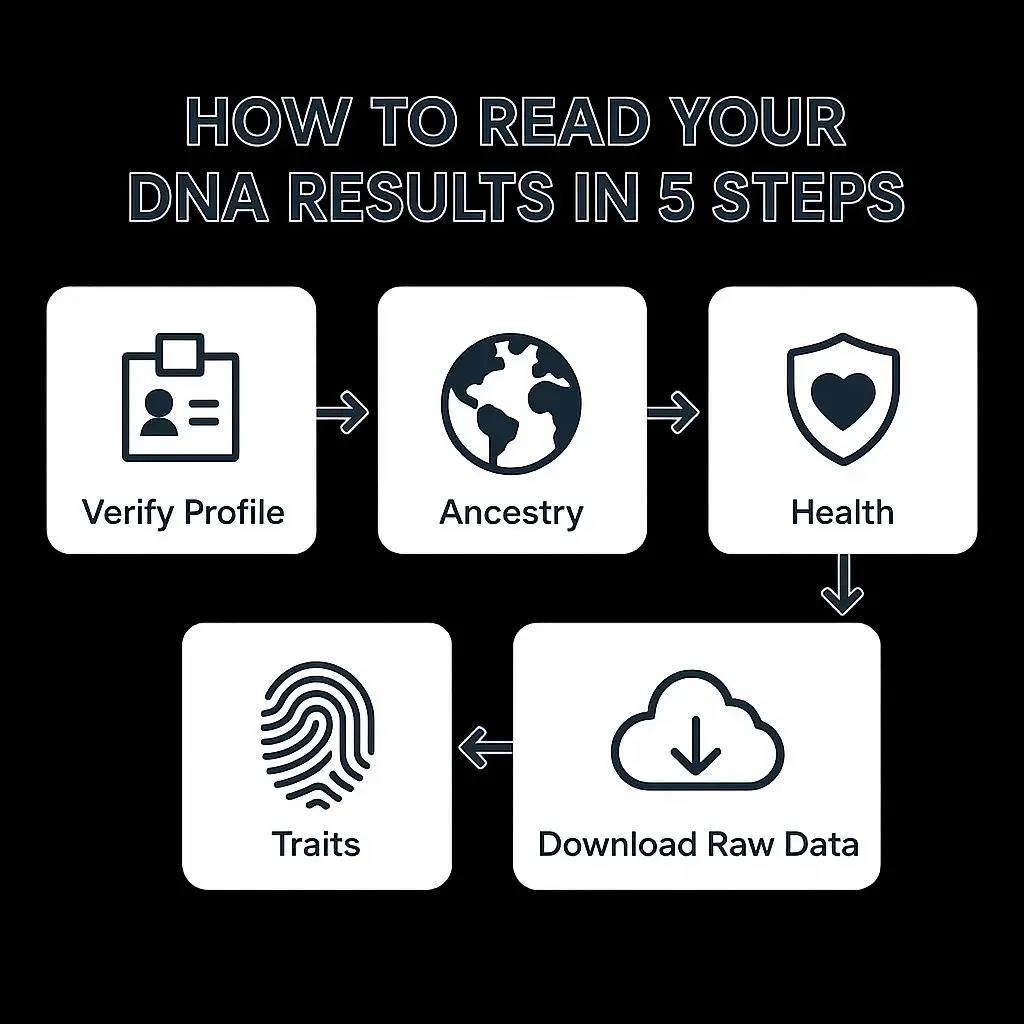
5 Simple Steps to Navigate Your DNA Test Results
Interpreting your DNA test results doesn’t have to be overwhelming. Following these five steps will help you methodically explore your genetic information, starting with the basics and progressing to more complex data. Take your time with each section, and remember that understanding your genetic makeup is a journey, not a race.
1. Check Your Basic Information
Begin by verifying that the basic information in your DNA test results is correct. This includes confirming your name, sample ID, and any other identifying information to ensure you’re looking at your own results. While mix-ups are rare, they can happen, especially if multiple family members have taken tests. Some testing companies may also ask you to complete a profile with additional information about your known ancestry, physical traits, or health history, which can help refine your results. Taking this initial step ensures you’re starting on the right foot before diving into the more detailed sections of your report.
2. Review Your Ancestry Composition
The ancestry composition section is often the most visually appealing and immediately gratifying part of your DNA results. This section breaks down your genetic heritage into percentages from different regions around the world. You might discover you’re 43% Eastern European, 27% Northwestern European, 15% East Asian, and so on. Many testing companies provide interactive maps that show the geographical distribution of your ancestry and allow you to explore specific regions in greater detail. Remember that these percentages represent genetic similarity to reference populations, not necessarily a direct lineage from these regions. They reflect where your ancestors may have lived hundreds or thousands of years ago, and can sometimes reveal surprising connections to regions you weren’t aware of in your family history. For more detailed insights, consider exploring DNA test and genetic testing resources.
3. Examine Health-Related Findings
If your DNA test includes health information, this section deserves careful attention and proper context. Health-related genetic findings typically fall into several categories: carrier status for recessive conditions, genetic health risks, and pharmacogenetic information about medication responses. It’s crucial to understand that most genetic health risks are probabilistic, not deterministic – they indicate a higher or lower chance of developing certain conditions, not certainty. For example, having a genetic variant associated with Type 2 diabetes might increase your risk, but lifestyle factors like diet and exercise still play major roles. Always consult with healthcare professionals before making medical decisions based on these results.
|
Health Report Type |
What It Tells You |
How to Interpret It |
|---|---|---|
|
Carrier Status |
If you carry genetic variants for recessive conditions |
Important for family planning; being a carrier usually doesn’t affect your health |
|
Health Predispositions |
Genetic factors that may increase risk for certain conditions |
Indicates possibility, not certainty; consider environmental factors too |
|
Pharmacogenetics |
How your body might process certain medications |
Discuss with doctor before changing any medication regimen |
4. Look at Trait Predictions
Trait predictions offer fascinating insights into your genetic predispositions for various physical and behavioral characteristics. These might include everything from earlobe type and hair texture to taste preferences and sleep patterns. While entertaining, remember that most traits are influenced by both genetics and environment. Your DNA might suggest a preference for sweet tastes, but your actual food preferences developed through a complex interaction between your genes and life experiences. Trait predictions typically show the variant you have for a particular gene and what percentage of people with that variant display the associated trait.
5. Access Your Raw Data
For those who want to dive deeper, most DNA testing companies allow you to download your raw genetic data. This information comes as a text file containing thousands of genetic markers and their values. While the raw data itself isn’t particularly useful to most consumers, it can be uploaded to third-party analysis tools like Sequencing.com for additional insights beyond what your original testing company provides. These platforms can analyze your genetic information for everything from nutrition recommendations to specific health risks not covered in your original report. Before sharing your raw data with any third-party service, carefully review their privacy policy to understand how your genetic information will be used and protected.
Understanding the Science Behind Your Results
To truly interpret your DNA test results, it helps to understand the basic science behind how these tests work. Consumer DNA tests don’t analyze your entire genome—they focus on specific points where human DNA commonly varies. By examining these strategic locations, testing companies can make accurate determinations about your ancestry, health predispositions, and traits without sequencing your entire genetic code. For more insight, explore what your DNA really tells you.
How DNA Testing Companies Analyze Your Sample
When you submit your DNA sample, the testing company extracts genetic material from your saliva or cheek cells. Most consumer tests use a technology called genotyping, which examines specific points in your DNA (SNPs) where variations commonly occur among humans. This differs from whole-genome sequencing, which reads every letter in your genetic code. The company then compares your genetic markers to various reference populations to determine your ancestry composition and identify variants associated with health conditions or traits. The entire process is automated and relies on sophisticated algorithms that match your genetic profile to established patterns seen in different populations around the world.
What SNPs and Markers Actually Mean
SNPs (Single Nucleotide Polymorphisms, pronounced “snips”) are the specific points in your DNA where individual building blocks may vary between people. Each SNP represents a location where a single nucleotide (A, T, G, or C) may differ among individuals. These variations can influence everything from physical traits to disease susceptibility. When your report references markers like “rs4988235” or similar codes, it’s referring to specific SNPs that have been cataloged and studied. Some variants are well-understood, with clear associations to traits or conditions, while others remain more mysterious with correlations that scientists are still investigating.
Confidence Levels: Why They Matter
Pay close attention to confidence levels or probability statistics in your results—they’re crucial for proper interpretation. Most DNA testing companies assign confidence ratings to their findings, especially for ancestry composition. A “high confidence” region might indicate a 90% or greater certainty, while “speculative” might mean just over 50% confidence in the assignment. Similarly, health risk assessments often include relative risk statistics that compare your risk to the general population. Understanding these confidence levels helps you distinguish between highly reliable findings and those that should be taken with a grain of salt. Some companies allow you to adjust confidence thresholds in your display settings, showing only high-confidence results or including more speculative findings.
Health Information in DNA Tests
Health-related genetic information requires particularly careful interpretation. Unlike ancestry results, which are primarily informational, health findings can have implications for your well-being and medical decisions. A thoughtful approach to these sections can help you extract valuable insights without unnecessary anxiety.
Carrier Status Reports
Carrier status reports indicate whether you carry genetic variants for recessive conditions that typically don’t affect you but could potentially be passed to children. Being a carrier means you have one copy of a gene variant associated with a condition, but you need two copies (one from each parent) for the condition to manifest. Common carrier screenings include cystic fibrosis, sickle cell anemia, and Tay-Sachs disease. These results are particularly relevant if you’re planning to have children, especially if your partner might also be a carrier for the same condition. In such cases, each child would have a 25% chance of inheriting the condition, making this information valuable for family planning.
Disease Risk Assessments
Disease risk assessments analyze genetic variants associated with increased likelihood of developing certain health conditions. These might include heart disease, type 2 diabetes, certain cancers, or Alzheimer’s disease. The keyword here is “risk”—these findings indicate probability, not certainty.
Most disease risk factors involve complex interactions between multiple genes and environmental factors. For example, having a genetic variant associated with heart disease doesn’t mean you’ll definitely develop the condition, especially if you maintain a healthy lifestyle.
When reviewing these assessments, look for both the relative and absolute risk numbers. Relative risk compares your likelihood to the average person, while absolute risk tells you the actual percentage chance of developing the condition. A 50% increase in relative risk might sound alarming but could translate to an absolute risk change from 2% to 3%—a much less concerning figure.
Pharmacogenetics: How Medications Affect You
Pharmacogenetic information reveals how your body might metabolize certain medications based on your genetic profile. These insights can be extremely valuable, as they may explain why you experience side effects from particular drugs or why some medications seem less effective for you than others. For instance, variants in the CYP2C19 gene can affect how you process certain antidepressants and antiplatelet drugs, potentially requiring dosage adjustments. Always discuss these findings with your healthcare provider before making any changes to your medication regimen, as your genetic profile is just one of many factors that determine appropriate treatment.
The Difference Between Risk and Diagnosis
Perhaps the most important concept to understand about health-related genetic information is the fundamental difference between risk factors and diagnoses. DNA tests identify genetic variants associated with increased or decreased probability of developing certain conditions—they don’t diagnose diseases. Having a genetic variant associated with breast cancer, for example, doesn’t mean you have or will definitely develop breast cancer; it simply indicates a risk factor that should be discussed with healthcare professionals.
Many conditions result from complex interactions between multiple genetic factors and environmental influences. Your lifestyle choices—diet, exercise, stress management, environmental exposures—often play a larger role in disease development than any single genetic variant. This is why genetic counseling is so valuable for putting health-related genetic findings into proper perspective.
Downloading and Transferring Your Raw Data
Most DNA testing companies allow you to download your raw genetic data as a text file, typically in a format like CSV or TXT. This file contains thousands of genetic markers identified by their rsID numbers (like rs4988235) and your specific genotype at each location (such as AA, AG, or GG). While this raw data might look like gibberish, it’s actually a portable version of your genetic information that can be uploaded to other services for additional analysis. To understand more about what your DNA reveals, you can explore genetic variants and what they tell you.
Transferring your raw data to third-party analysis platforms like Sequencing.com can unlock insights beyond what your original testing company provides. These services often specialize in specific aspects of genetic analysis, such as health risks, nutrition, fitness, or ancestry details that weren’t covered in your original report. Some even allow you to compare results from different testing companies to get a more comprehensive picture.
- Download your raw data from your testing company’s website (usually found in settings or account options)
- Save the file securely on your computer – it contains sensitive personal information
- Research reputable third-party analysis services before uploading
- Check privacy policies carefully before sharing your genetic data
- Consider using services that analyze your data without storing it permanently
Before uploading your data to any third-party site, carefully review their privacy policy. Some services may claim ownership of your genetic information or share it with research partners. Look for platforms that prioritize user privacy, allow you to delete your data at any time, and are transparent about how they use your information.
Remember that your raw genetic data is incredibly personal and valuable. Treat it with the same care you would other sensitive information like your social security number or medical records. Store the downloaded file securely and be selective about which platforms you share it with.
Making Sense of Contradictory Results
One of the most confusing aspects of DNA testing occurs when you take tests from multiple companies and receive seemingly contradictory results. You might be 42% Scandinavian on one test but only 28% on another. Or perhaps one test identifies a health risk that another doesn’t mention at all. These discrepancies don’t mean the tests are inaccurate – they reflect differences in methodology, reference populations, and the specific genetic markers being analyzed.
Understanding why these contradictions occur can help you reconcile the differences and extract valuable insights from multiple tests. Rather than seeing these variations as a problem, consider them as different perspectives on your genetic information, each offering unique pieces of your genetic puzzle. For more information on the nuances of DNA testing, explore the difference between ancestry and health DNA testing.
Why Different Companies May Show Different Results
Each DNA testing company uses its own proprietary algorithms, reference populations, and sets of genetic markers to analyze your DNA. For ancestry testing, companies like 23andMe, AncestryDNA, and MyHeritage have collected different reference samples from around the world, and they may define geographical regions differently. One company might lump several countries into a single “Eastern European” category, while another breaks that region down into more specific areas.
For health-related results, companies analyze different sets of genetic variants associated with various conditions. Some may look at only a handful of well-established markers for a given condition, while others might include more recently discovered associations. Additionally, companies update their algorithms and databases at different times, so one service might be working with more current research than another.
Example: Ancestry Composition Differences
Company A: 45% British & Irish, 30% French & German, 15% Broadly Northwestern European, 10% Eastern European
Company B: 38% British Isles, 25% Central European, 22% Scandinavian, 15% Eastern European
Health-related discrepancies can be particularly concerning, but they often reflect the complex nature of genetic risk factors. If one test indicates a potential health risk that others don’t mention, it doesn’t necessarily mean the finding is incorrect – it may be that only one company tests for those specific genetic markers. When in doubt about health-related findings, consulting with a genetic counselor can help clarify these apparent contradictions.
The best approach is to consider results from multiple companies as complementary rather than contradictory. Each test examines your genetic information through a slightly different lens, and together they can provide a more comprehensive picture of your genetic makeup than any single test alone.
How Testing Algorithms and Reference Populations Affect Outcomes
The reference populations used by testing companies significantly impact your results, especially for ancestry composition. These reference databases consist of DNA samples from individuals whose family histories are well-documented in specific geographical regions. The size, diversity, and distribution of these reference populations vary between companies, directly affecting how your DNA is categorized.
Companies also differ in how they define geographical regions and ethnic groups. For instance, what one company calls “Mediterranean” might overlap with regions another company categorizes as “Southern European” and “North African.” Similarly, the boundaries between “Eastern European” and “Western Asian” might be drawn differently across platforms. These categorical differences naturally lead to percentage variations in your ancestry composition results. To understand more about these differences, you might want to explore the difference between ancestry and health DNA testing.

Your DNA, Your Privacy: Important Considerations
When you submit your DNA for testing, you’re sharing the most personal data possible – your genetic code. Understanding the privacy implications of DNA testing is crucial for making informed decisions about who can access your genetic information and how it might be used now and in the future. While DNA testing offers valuable insights, it also introduces unique privacy considerations that differ from other types of personal data. For more information on what your DNA can reveal, check out this article on understanding genetic variants.
Who Can Access Your Genetic Information
- The testing company and its employees who process samples
- Research partners, if you’ve consented to research participation
- Third-party services where you upload your raw data
- Potential genetic relatives who have also taken the test
- Law enforcement agencies under certain circumstances
- Health insurance companies (in countries with fewer genetic privacy protections)
Testing companies have varying policies regarding data sharing and storage. Most reputable companies will not share your identifiable genetic information without your explicit consent, but many do offer opt-in research programs that use anonymized genetic data for scientific studies. These programs can contribute to valuable medical research, but participation is a personal choice that depends on your comfort level with sharing your genetic information. If you’re curious about how your genetic data might be used, you can explore DNA testing for health to understand more.
In the United States, the Genetic Information Nondiscrimination Act (GINA) prohibits health insurance companies and employers from discriminating based on genetic information, but this protection doesn’t extend to life insurance, disability insurance, or long-term care insurance. Other countries have different levels of protection, so it’s important to understand the legal framework where you live.
Another consideration is that your genetic information doesn’t just reveal information about you – it also contains data relevant to your biological relatives. When you take a DNA test, you’re potentially exposing genetic information about your entire biological family, including those who haven’t consented to testing. This shared nature of genetic data creates unique ethical considerations not present with other types of personal information.
Sharing Settings and Their Implications
Most DNA testing platforms offer customizable privacy settings that determine who can see your information and how it can be used. These typically include options for participating in relative-matching features, research programs, and whether your data can be shared with third parties. Taking time to understand and configure these settings according to your comfort level is an essential step in managing your genetic privacy.
The relative-matching feature, which connects you with potential genetic relatives who have also taken the test, requires sharing some of your genetic information and contact details with matches. While this feature is valuable for genealogical research and finding biological family, it also means that strangers who share your DNA can view your profile. If privacy is a primary concern, you might choose to disable this feature or use a pseudonym for your testing account. For more details on DNA testing and privacy, you can explore further resources.
Law Enforcement and DNA Databases
In recent years, law enforcement agencies have increasingly used genetic genealogy to solve cold cases by uploading crime scene DNA to public databases like GEDmatch. This has led to the identification and conviction of numerous violent criminals, most famously the Golden State Killer. While these successes highlight the potential public safety benefits of DNA databases, they also raise questions about genetic privacy and consent.
Most major testing companies require a court order or warrant before providing customer information to law enforcement. However, if you upload your raw data to public databases or third-party sites with less stringent privacy protections, you may be inadvertently making your genetic information more accessible. Some services now offer specific opt-in or opt-out options for law enforcement matching, allowing users to decide whether their DNA can be used for these purposes.
Next Steps After Understanding Your Results
After interpreting your DNA test results, you might wonder what to do with this new information. For ancestry findings, consider diving deeper into genealogical research, connecting with newly discovered relatives, or exploring the cultures and histories of your ancestral regions. For health-related insights, discuss significant findings with healthcare providers who can help put the information in context and recommend appropriate screening or preventive measures. You might also consider consulting with a genetic counselor who specializes in interpreting genetic test results and can provide personalized guidance. Remember that your DNA results are just one piece of your health and identity puzzle – they provide valuable insights, but don’t define who you are or determine your destiny. Sequencing.com offers tools that can help you take the next step in your genetic journey, allowing you to analyze your raw data for additional insights not covered in your original report.
Frequently Asked Questions
As you navigate your DNA test results, you’ll likely have questions about what the information means and how reliable it is. The following frequently asked questions address common concerns and misconceptions about DNA testing and results interpretation. Understanding these nuances will help you get the most value from your genetic information while maintaining realistic expectations about what these tests can and cannot tell you.
Remember that genetic science is rapidly evolving, and our understanding of how specific genetic variants affect health and traits continues to improve over time. What seems uncertain today may become clearer as research progresses and testing companies update their algorithms and databases.
How accurate are direct-to-consumer DNA tests?
Direct-to-consumer DNA tests are generally quite accurate at the technical level of reading your genetic markers – typically 99%+ accurate for the specific SNPs they analyze. However, the interpretation of those markers, especially for ancestry and trait predictions, involves statistical models and reference populations that introduce variability.
Ancestry composition accuracy depends largely on the company’s reference population for your particular heritage. Results tend to be more accurate for people with European ancestry because these populations are overrepresented in most reference databases. Companies continuously improve their accuracy by expanding their reference populations to include more diverse genetic backgrounds. To understand more about the differences between ancestry and health testing, you can explore this detailed comparison.
Health-related findings vary in reliability depending on the condition. Some genetic associations, like those for BRCA mutations and certain inherited conditions, are well-established with strong scientific evidence. Others, particularly for complex conditions influenced by multiple genes and environmental factors, should be considered probabilistic rather than definitive.
Trait predictions typically have the lowest accuracy level, as most physical and behavioral traits result from complex interactions between multiple genes and environmental factors. These predictions are best viewed as interesting insights rather than definitive statements about your characteristics.
- Technical accuracy (correct reading of genetic markers): 99%+
- Ancestry composition accuracy: Varies by company and your specific heritage
- Health risk assessment accuracy: Depends on the specific condition and available research
- Trait prediction accuracy: Generally lower due to complex gene-environment interactions
- Relative matching accuracy: Very high for close relationships (siblings, parents), decreases for distant relationships
Can I update my DNA results if new research becomes available?
Yes, most major DNA testing companies periodically update their interpretation algorithms and databases as new research becomes available. These updates typically happen automatically, so you may notice changes to your results over time without having to submit a new sample. The frequency of these updates varies by company, with some providing several updates per year and others updating less frequently. If you’re using third-party analysis tools, check whether they offer updated interpretations as genetic science evolves.
Should I be worried if my DNA test shows disease risk?
Finding out you have genetic variants associated with increased disease risk can be concerning, but it’s important to put this information in the proper context. Most genetic risk factors identified in consumer DNA tests represent modest increases in risk, not guarantees of developing the condition. Many health conditions result from complex interactions between multiple genetic factors and environmental influences like diet, exercise, and exposure to toxins. A positive result for a genetic risk factor should be viewed as information that empowers you to take preventive measures and discuss appropriate screening with healthcare providers, not as a cause for anxiety or a predetermined health outcome. For more insights, explore how your genes influence your health.
Why do my ethnicity results differ between testing companies?
Ethnicity results vary between companies primarily because each uses different reference populations, regional classifications, and analysis algorithms. AncestryDNA, 23andMe, MyHeritage, and other companies have built their own proprietary databases of reference samples from around the world. The size and composition of these reference panels directly impact how your DNA is categorized.
Additionally, companies define geographical regions differently. What one company labels as “Scandinavian” might include areas another company categorizes as “Northwestern European” or splits into more specific regions like “Swedish” and “Norwegian.”
Common Reasons for Ethnicity Estimate Differences:
• Different reference populations used for comparison
• Varying definitions of geographical regions
• Different statistical models for ancestry analysis
• Varying thresholds for reporting small percentage results
• Updates to algorithms and reference panels at different times
Rather than seeing these differences as contradictions, consider them complementary perspectives on your genetic ancestry. Some users find it helpful to average percentages across multiple tests or focus on the broad patterns rather than specific numbers. For instance, if all tests show you have primarily European ancestry with some African components, that pattern is likely reliable even if the exact percentages differ.
Remember that ethnicity estimates reflect genetic similarity to reference populations, not a definitive family tree or cultural heritage. They represent statistical approximations based on current science, not absolute facts about your ancestral origins.
Is it safe to upload my raw DNA data to third-party sites?
Uploading your raw DNA data to third-party analysis services can provide valuable insights beyond what your original testing company offers, but it does come with privacy considerations. Before sharing your genetic information with any platform, carefully review their privacy policy, data storage practices, and terms of service.
Look for services that prioritize user privacy with features like data encryption, options to delete your information permanently, and clear policies about data sharing. Some services analyze your data without storing it long-term, which can provide additional privacy protection. Be particularly cautious with free services, as they may monetize your genetic information through data sharing or targeted advertising.
Reputable services like Sequencing.com maintain strict privacy standards and give users control over how their genetic information is used and shared. They offer transparent policies about data security and don’t sell user information to third parties without explicit consent.
Turn insights into an action plan.
Your DNA is just the starting point. Get evidence-based, personalized guidance on nutrition, lifestyle, and next steps from experts who speak “genetic” fluently.
Get Personalized Guidance at Zenith Vital Wellness